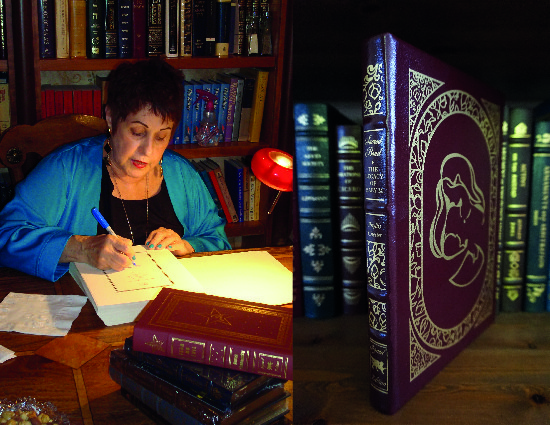
A Belated Apology to My "Seder Sister"
How I Spent Rosh Hashana
Sep 14, 2026
Dearest E.M. (Esther Broner):
This is a belated letter to you, one that I wish I'd sent long before you died. But it is never too late to "talk to the dead," is it?
We broke apart, you and I, when you published your book The Telling in 1992. Please forgive me, but your incantatory and performative prose left so many facts far behind as you wove your spells. I should have understood that everything you wrote was essentially a continuing novel, a form of magic, and that your woman-centered rituals and ceremonies were meant to bring women together, to heal our brokenness. You were like those Greek Sibyls, who were always "elsewhere" and stoned as they foretold the destinies of both Kings and servants.
Esther, you conducted yourself as our High Priestess, our ceremonial ritualist, a magician of sorts. Your words were meant to cast a spell, to enchant. Your novels (which I loved) were all versions of magic realism.
I loved your books: Her Mothers, A Weave of Women, The Lost Tradition: Mothers and Daughters in Literature.
You praised me to high heaven in The Telling. You described me as a "prophet," a "dream interpreter," as "dark and voluptuous," and as an "Amazon among the Orthodox Women of the Wall."
I still was not able to bear how secretive you were about publishing a book all about us, your feminist Seder Sisters, without once having mentioned it, without ever asking us (at least you did not ask me) to check the dates, the spelling of names, or the actual events with which I was integrally involved—events that you chose to describe so very imaginatively, as if they all took place in a dream, as if you were dreaming us into being.
In The Telling, and again in Bringing Home The Light: A Jewish Woman's Handbook of Rituals, you did not share the real reason that I did not join us for what would have been my last seder. I had implored us to finally keep it small, intimate, and to not invite the media. Everyone agreed to do so. At the last moment, you called me and said that your very life, your future as a writer, was now in my hands; that everyone else had since agreed to allow Margo Adler of NPR—just one journalist—to come and tape us live.
Do you remember this?
I sighed and took a very deep breath and told you that you had nothing to worry about, that my last ritual for us would be that of refusing to worship that golden calf, our carefully crafted public image that seemed to mean so much to all of us. Me, too. Our ability to influence and inspire other women to perform their own sedarim "in our image," so to speak--yes?--but what might have been a noble cause also smacked of idolatry to me. At least at that moment.
Still, please forgive me. I took myself so seriously, took my burgeoning Torah study and my responsibility towards my unexpected co-leadership of the Women of the Wall struggle so seriously that I found it too hard to appreciate how fast and loose you played with the facts, even for a good cause.
I should have supported your book, despite its factual flaws, simply because you were my "sister." I did not do so. Instead, I lashed out, fiercely and with self-righteous anger.
Once again, please forgive me.
But, let's be honest, these sedarim were not only for the sake of Heaven. They were also about creating a powerful in-group of women, all of whom had enormously impressive accomplishments; a group of feminist "sisters" who would constitute the mothering most of us had not had; a spiritually oriented, woman-centered, supportive feminist community, which few of us really had. And this, you accomplished. We turned up when one of us decided to say kaddish for a dead father, when one of us gave birth, when one of us celebrated a Bar Mitzva, when one of us presided over a conference, when we had hysterectomies, lost our partners to others, entered menopause, developed cancer or other illnesses.
The "biggest" names--and there were so many such names--yearned for invitations, and some came to stay. One of us directed a film about us. We appeared in so many articles across our country and around the world.
Ah, my Esther. Once, we loved each other so. And then we never again spoke.
I now regret this. How could I not? It is Rosh Hashana, and I am turning 86 in a few weeks and thinking things over. I may have been "right" about the facts, about the idol worship, but I should have valued community just as much. I should have acted with more humility (leaders are supposed to do so, yes?). I should have forgiven each of us for being only human: flawed, competitive, ambitious, envious, needy, selfish, vulnerable, prone to lashon hara, "evil tongue," easily tempted into bad mouthing each other.
I had begun to study Torah in 1989, and how we may have used//abused the Passover ritual as our way to talk about American Presidents, racism, Israel-"Palestine," the Iraq war, nationalism, Black-Jewish relations--well, it all became increasingly painful to me. Perhaps I needed something quite apart from mere politics or feminist issues.
I am writing this letter primarily to you, dear Esther, but also to so many of our also dearly departed sisters and one who is not exactly "here" anymore. Now, there may only be two of us Originals still standing and one who came eight or nine years later but who has stayed the course ever since.
Please allow me to set a very small part of our public record straight.
As the late great Queen Elizabeth II famously said: "Recollections may vary."
They can, but facts are also facts. Revisionist histories help no one.
Here are some increasingly revised or simply misunderstood facts about our fabulous, feminist, very, very famous feminist seder.
In 1975, you and Naomi Nimrod conducted a first-ever feminist seder in Haifa. That's when and where we first met. I had delivered a lecture in Haifa and was very enthusiastic about the idea of your feminist seder. I suggested that we bring the "show" to NYC. Thereafter, when you returned to America, first to Michigan and then to New York City, you courted me (there is no other word for it). It was very heady stuff and I loved it. I was in charge of whom to invite, and so, I invited a precious handful of feminist friends, well known to me but not yet to you.
I invited Gloria Steinem, Lilly Rivlin, Bea Kreloff, Edith Issac-Rose, and Letty Cottin Pogrebin. We became a core group. Esther called us "The Seder Sisters." That first year, I had just appeared on the Phil Donohue show in Chicago to talk about my 1976 book Women, Money, and Power, together with the then-reigning Miss USA, Summer Bartholomew. Summer sat next to me on the plane back to NYC. She was very young and, without a doubt, "pretty." Nevertheless, Summer, who was 24 years old at the time, asked me whether I really, truly thought that she was "pretty" because she did not think so. I immediately invited her to join me at a feminist Jewish gathering that very evening, which was taking place at my then-West End Avenue apartment.
I thought she needed some feminist energy and ideas ASAP.
That first, time, I spread a tablecloth on the floor, and we all sat around it like the Jewish Arabs that we were, still wandering in the desert. The excitement was infectious. Esther, you and I were the co-leaders, but Lilly ("Rivlin") and I also collaborated on a closing ritual that we varied from year to year. Bea and Edith were primarily secular lesbian painters--and proudly so. Letty brought exceptionally delicious food and clung fast to the continuation of this feminist seder.
Year after year, articles were written by some of us and about us. An increasing number of women wanted to be part of this "happening" excitement. More and more came and an increasing number were public figures and feminist "players."
The actual Haggadah, the "story" we were meant to follow, changed every year. Esther, you were somewhat madcap in this way, feverishly creative, always evolving.
Perhaps I was the one who changed and what seemed to stay the same was this: Our event remained a political, feminist, and secular event. The slavery of the Jews and our freedom no longer mattered. We elevated Miriam and dropped Moshe. The plagues visited upon Egypt became the patriarchal plagues visited upon women. We did not allow sons, husbands, brothers, fathers to join us--except once. It was as if we had learned nothing about what being excluded from Jewish rituals was like.
I will say no more.
This letter is my Rosh Hashana t'shuvah. I am apologizing to you and to God, but especially to you, dear Esther.
Enough said--until we meet again.